
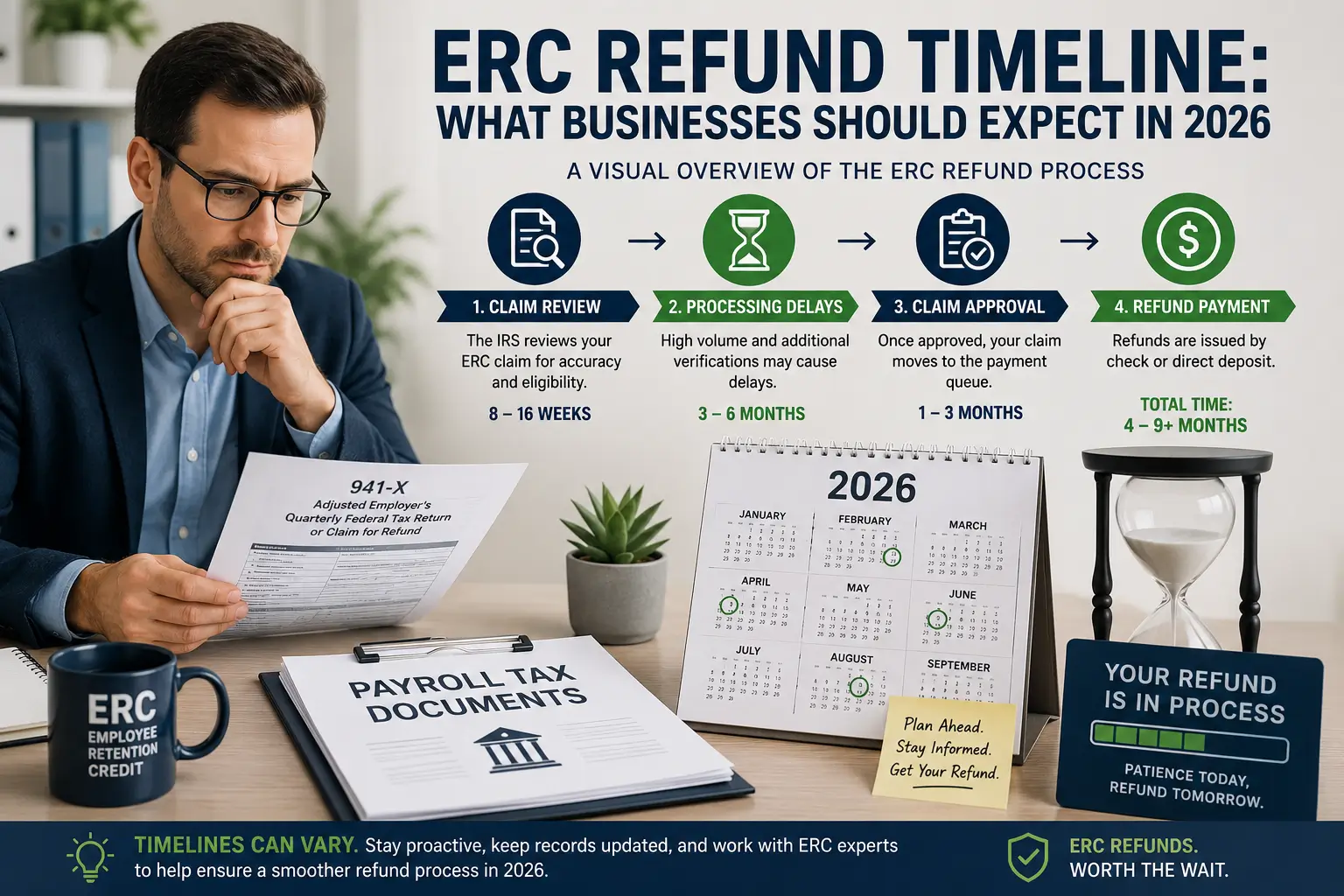
Businesses waiting for an Employee Retention Credit refund usually have one central question: When will the IRS review and pay the claim? The ERC refund processing time 2026 remains a major concern for employers with pending claims. There is no single answer that applies to every employer because remaining claims are at different stages.
The ERC refund processing time 2026 depends on whether a claim is undergoing an initial review, awaiting payment, under audit, facing disallowance, or being considered by the IRS Independent Office of Appeals. Although the historic backlog has fallen substantially, some businesses are still waiting for a final decision.
This guide explains the ERC refund timeline, current IRS inventory, reasons claims remain delayed, claim-specific problems, and practical ways to monitor progress.
ERC Refund Timeline
The Employee Retention Credit is a refundable employment tax credit available to eligible businesses and tax-exempt organizations affected by the COVID-19 pandemic. Most businesses requested refunds by filing an adjusted employment tax return, generally Form 941-X, for each applicable quarter.
A claim generally moves through these stages:
| Stage | What generally happens |
| Form 941-X filed | The employer submits an adjusted return for a particular tax quarter |
| IRS receipt | The return reaches the IRS and enters its processing system |
| Initial processing | The IRS checks identifying information, the tax period, and amended figures |
| Compliance review | The IRS may examine eligibility, qualified wages, and supporting records. |
| Decision | The IRS may approve, adjust, audit, or disallow the claim. |
| Payment processing | The IRS may refund an allowed overpayment or apply it to another federal tax debt. |
| Appeal or dispute | A business may challenge a full or partial disallowance |
However, filing Form 941-X does not automatically guarantee payment. The IRS must determine whether the business qualified for the credit and whether the amount claimed was calculated correctly.
As a result, because employers normally file a separate adjusted return for each quarter, claims for different quarters can follow different paths. One quarter may be approved while another remains under review, examination, or appeal.
Typical Timeline
The IRS does not provide one guaranteed number of weeks or months for all ERC claims. However, earlier estimates for ordinary amended payroll returns are unreliable for the remaining ERC inventory because many unresolved claims involve compliance reviews, examinations, or disputes.
A typical claim may move through four broad phases.
Filing and initial processing
The process begins when the employer files Form 941-X. Businesses should retain a complete copy of the return, proof of delivery, the filing date, the claimed quarter, and all supporting calculations.
Delivery confirmation proves that a package reached the IRS. It does not prove that the claim has been approved or fully entered into the employer’s tax account.
Eligibility review
The IRS may assess whether the employer satisfied the eligibility rules that applied to the claimed period. It may review gross-receipts calculations, qualifying government orders, employee counts, payroll records, health-plan expenses and the treatment of Paycheck Protection Program wages.
The ERC requirements differ depending on the quarter and period the business claimed.
Approval, adjustment or disallowance
Following review, the IRS may allow the full claim, approve only part of it, request additional information, begin an examination, or disallow the claim.
A claim being “processed” does not necessarily mean it has been approved. Similarly, a claim described as “closed” may have been paid, denied, withdrawn, or otherwise resolved.
ERC Refund Payment and Processing
When a claim is allowed, the IRS may issue a refund or apply the overpayment against another federal tax liability. The IRS may complete separate quarterly claims at different times, so receiving one check does not confirm approval of all other quarters.
ERC Refund Processing Time 2026: Current IRS Inventory
The latest IRS figures must be treated as the current position, rather than relying on the much larger backlog reported in earlier years.
As of the week ending July 4, 2026, the IRS reported approximately 20,000 ERC claims remaining across several stages:
| Current stage | Approximate claims |
| Under review | 3,000 |
| Pending payment or disallowance | 4,100 |
| Under audit | 5,200 |
| Awaiting review of disallowance responses | 6,100 |
| With the Independent Office of Appeals | 1,600 |
| Total remaining | 20,000 |
The IRS says it plans to update this inventory monthly.
These figures show why there is no universal ERC refund processing time in 2026. A claim awaiting routine payment is in a different position from one under audit or waiting for review of a disallowance response.
The Taxpayer Advocate Service reports that the IRS currently plans to complete the initial review of all ERC claims by December 31, 2026. That wording is important. Completing an initial review does not necessarily mean every claim will be approved, paid, or fully resolved by that date. Audits, appeals, and disallowance disputes may continue afterward.
Older information may still be used for historical context. GAO reported that the IRS had processed nearly five million claims by June 2025 and that IRS officials said most claims were closed by the end of 2025. However, those figures describe the earlier program-wide backlog, not the current July 2026 inventory.
A 2025 law also affected certain late-filed claims. The IRS states that ERC claims for the third or fourth quarter of 2021 generally cannot be allowed or refunded when filed after January 31, 2024, subject to the law’s specific conditions.
Why the ERC Refund Processing Time Is Taking Longer in 2026
Several broad factors created the extended ERC timeline. These factors continue to affect the ERC refund processing time 2026 for businesses with unresolved claims.
High claim volume
The IRS received millions of claims, many of them through paper-filed amended employment tax returns. GAO found that manual processing and limited data capture complicated both refund processing and compliance work.
September 2023 moratorium
The IRS introduced a processing moratorium in September 2023 after identifying significant concerns about improper claims and aggressive marketing. The pause allowed the agency to strengthen compliance reviews, but it also lengthened the wait for many businesses.
Improper-claim concerns
The IRS continues to closely review ERC returns because of concerns about ineligible or overstated claims. These reviews are intended to separate valid claims from submissions that involve incorrect eligibility interpretations, unsupported wages, or promoter-driven errors.
Complex eligibility rules
Eligibility may depend on gross receipts, qualifying government orders, operational effects, employee counts, related-party rules, qualified wages, and interactions with other relief programs. These issues often require more than a basic mathematical check.
Audits, disallowances and appeals
A substantial share of the remaining inventory is not simply waiting for routine payment. As of July 4, 2026, thousands of claims were under audit, awaiting review of disallowance responses or assigned to Appeals.
What Can Delay an ERC Refund?
The previous section explains system-wide causes. Individual claims may also be delayed by specific problems.
Common issues include:
- An incomplete, inconsistent or unsigned Form 941-X
- An incorrect EIN, business name, address or claimed quarter
- Differences between the original Form 941 and the amended return
- Unsupported qualified-wage calculations
- Wages counted for both ERC and PPP loan forgiveness
- Missing gross-receipts calculations or government-order evidence
- Related-party wages or employee-count errors
- Unanswered IRS correspondence
- Examination selection
- Full or partial disallowance
- Outstanding federal tax liabilities that may absorb an approved overpayment
Businesses should keep copies of payroll reports, Forms 941 and 941-X, health-plan expenses, gross-receipts comparisons, government orders, PPP records, wage-allocation schedules and every IRS notice.
A business receiving Letter 105-C has been notified that the IRS disallowed its claim. Letter 106-C generally concerns a partial disallowance. Businesses that disagree should review the reason, provide supporting documentation, and pay close attention to the legal deadline.
Taxpayers generally have two years from the date of the disallowance letter to resolve the matter administratively or file a refund suit. Filing an administrative appeal does not automatically extend that period. In qualifying situations, Form 907 may be used to request an agreed extension before the deadline expires.
How to Monitor Your ERC Refund Status in 2026
There is no public, real-time ERC tracker comparable to the individual “Where’s My Refund?” tool. Businesses may also use an ERC tracking service for additional help reviewing claim progress and available updates.
Check the IRS Business Tax Account
An eligible business may use its Business Tax Account to review available account information, notices, balances and tax records. The account can reveal useful activity, but it should not be described as a live ERC refund-status dashboard.
Review business tax transcripts
A transcript may show posted adjustments, account activity or refund-related transactions. However, a recently filed or manually processed Form 941-X may not appear immediately, and transcript codes do not always confirm that a refund check has already been issued.
Call the IRS business line
Businesses may contact the IRS Business and Specialty Tax Line at 800-829-4933. Before calling, prepare the legal business name, EIN, claimed quarters, filing dates, refund amounts, copies of Form 941-X, proof of delivery, and any IRS letters.
Calling usually does not accelerate processing, but it may reveal whether a return is missing, under examination, disallowed, adjusted or awaiting further action.
Monitor all IRS correspondence
Businesses should open and review IRS mail promptly. A notice may request records, explain an adjustment, announce an audit, disallow a claim or establish a response deadline.
Use an authorized professional when necessary
A qualified CPA, enrolled agent or tax attorney may help interpret transcripts, respond to examinations, organize evidence or contest a disallowance. No professional can guarantee that a claim will be approved or paid by a particular date.
Businesses experiencing serious financial hardship or an unresolved IRS problem may also consider contacting the Taxpayer Advocate Service. TAS involvement does not guarantee payment, but the organization continues to advocate for faster handling of qualifying hardship cases.
Conclusion
The ERC refund timeline in 2026 depends on the stage of each claim. As of July 4, 2026, the IRS reported about 20,000 remaining claims across review, audit, payment, disallowance, and Appeals. Businesses should track each quarter separately, monitor IRS notices and transcripts, keep complete records, and respond quickly to any request for information. There is no guaranteed processing time for ERC refunds in 2026, so careful monitoring and timely action remain essential.
FAQ’S
There is no single guaranteed processing period. As of July 4, 2026, approximately 20,000 claims remained across review, payment or disallowance processing, audits, disallowance-response review and Appeals. A claim’s stage is more useful than a general estimate.
There is no dedicated real-time ERC tracker. Businesses may review available records and transcripts through an IRS Business Tax Account, monitor notices and call the IRS for account-specific information.
Each quarter is generally claimed on a separate adjusted return. The IRS may approve one quarter while reviewing, auditing or disallowing another.
Yes. The IRS may allow certain wages, amounts or quarters while disallowing others. A partial disallowance is generally explained through IRS correspondence.
Usually not. Calling can clarify the status or identify a problem that requires action, but it does not normally move a valid claim ahead of others.
Review the reason, decision date, appeal rights and two-year deadline immediately. Gather documentation supporting eligibility, filing timeliness and the claimed amount. Because an appeal does not automatically extend the court-filing deadline, professional advice may be appropriate.
No. A remaining claim may ultimately be approved, partially approved, disallowed, withdrawn or resolved through audit or appeal. Pending status does not prove eligibility.
Businesses waiting for an ERC decision in 2026 should focus on the status of each claimed quarter, preserve complete documentation and respond promptly to IRS correspondence.