
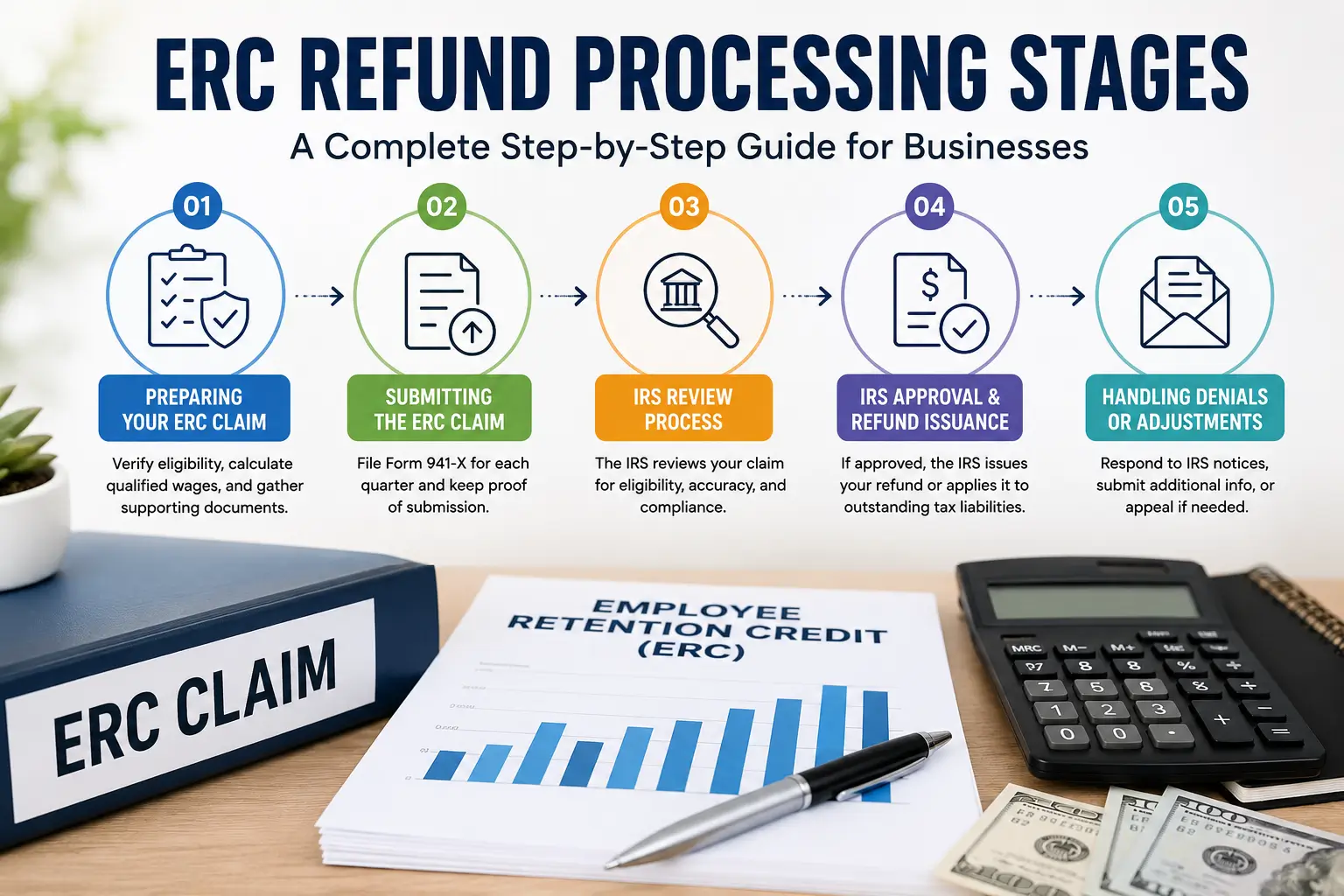
Understanding the ERC Refund Processing Stages helps businesses determine what may happen after they submit an Employee Retention Credit claim. Although the general claim period has ended, previously filed claims may still be under review, examination, payment processing, disallowance review, or Appeals.
The IRS does not provide one guaranteed processing timeline for every claim. A straightforward claim awaiting payment is different from one selected for audit or involved in a disallowance dispute. The Taxpayer Advocate Service reports that the IRS currently plans to complete the initial review of all ERC claims by December 31, 2026. However, initial review does not guarantee that every claim will be approved, paid, or finally resolved by that date.
This guide explains the complete process, from claim preparation and submission through IRS review, payment, adjustment, or denial.
What Is an ERC Refund?
The Employee Retention Credit is a refundable employment tax credit created for eligible businesses and tax-exempt organizations affected by the COVID-19 pandemic. Eligible employers could claim the credit for qualified wages paid between March 13, 2020, and December 31, 2021, although eligibility requirements varied by period.
Most employers requested the credit by filing Form 941-X, Adjusted Employer’s Quarterly Federal Tax Return or Claim for Refund, for each applicable quarter.
An ERC claim is not automatically an approved refund. Filing Form 941-X asks the IRS to adjust the employer’s payroll tax account or issue a refund. The IRS must still verify eligibility, qualified wages, calculations, and other information before allowing the claim.
Step 1: Preparing Your ERC Claim
The first of the ERC Refund Processing Stages involves verifying the claim and organizing the supporting evidence. Because the general filing period has closed, this information is especially useful for businesses reviewing previously submitted claims or responding to an IRS examination.
Confirm eligibility by quarter
Eligibility must be evaluated separately for every quarter. Depending on the applicable period, a business may have qualified because it:
- Experienced a full or partial suspension under an appropriate government order;
- Had the required decline in gross receipts; or
- Met the requirements for a recovery startup business.
Businesses should preserve the records used to support the eligibility test. A general statement that the pandemic affected business activity may not be enough to establish eligibility.
Verify qualified wages
The calculation may depend on the claim period, employer size, employee relationships, eligible health-plan expenses, and other relief programs.
Businesses that received Paycheck Protection Program loan forgiveness must also show how they allocated wages. They generally cannot use the same wages to support both PPP forgiveness and the ERC when double counting is prohibited.
Organize the supporting documents
A claim file should include:
- Original Forms 941 and amended Forms 941-X;
- Payroll registers and wage calculations;
- Health-plan expense records;
- Gross-receipts comparisons;
- Relevant government orders;
- PPP loan-forgiveness documents;
- Employee-count calculations; and
- Copies of IRS correspondence.
Current IRS instructions state that records related to certain ERC-qualified wages paid after June 30, 2021, should be retained for at least seven years.
Step 2: Submitting the ERC Claim
Employers generally submitted ERC refund claims on Form 941-X. Because the credit was reported quarterly, businesses normally filed a separate amended return for each affected quarter.
The form should contain the correct:
- Employer identification number;
- Legal business name;
- Tax quarter;
- Corrected payroll amounts;
- Credit calculation;
- Explanation of the correction; and
- Authorized signature.
Businesses should retain a complete copy of each return, its filing date, the requested amount, and proof of mailing or delivery. Delivery confirmation shows that the IRS received a package, but it does not establish that the claim entered processing or received approval.
A current legal limitation also affects some late claims. The IRS states that certain ERC claims for the third or fourth quarter of 2021 generally cannot be allowed or refunded when filed after January 31, 2024, subject to the law’s specific provisions.
Step 3: ERC Refund Processing Stages During IRS Review
IRS review is usually the most uncertain part of the process. Although individual claims can follow different paths, the main stages are generally as follows.
Receipt and initial processing
The IRS receives the amended return, verifies the identifying information, and associates it with the employer’s tax account. Since amended payroll returns commonly require paper and manual processing, account updates may not appear immediately.
Eligibility and compliance review
The IRS may examine whether the employer satisfied the qualification rules for the claimed quarter. Reviewers may consider gross receipts, government orders, payroll records, employee counts, health-plan expenses, ownership details, and PPP wage allocations.
Examination or audit
The IRS may select a claim for a detailed examination. In that situation, it can request calculations, payroll records, financial documents, or an explanation of the eligibility position.
The business should respond within the stated deadline and retain copies of everything it submits.
Decision
After reviewing the claim, the IRS may:
- Approve the requested amount;
- Approve only part of it;
- Correct or adjust the calculation;
- Disallow the claim;
- Continue an examination; or
- Refer a disputed matter to Appeals.
Businesses should not treat “received,” “processed,” “closed,” “approved,” and “paid” as equivalent terms. For example, a closed claim may have been paid, denied, withdrawn, adjusted, or otherwise resolved.
The Government Accountability Office reported that the IRS had processed nearly five million ERC claims by June 2025. According to IRS officials cited by GAO, the agency closed most claims by December 31, 2025. However, examinations, disallowance disputes, Appeals cases, and other unresolved matters continued beyond that broader milestone.
Step 4: IRS Approval and Refund Issuance
When the IRS approves a claim, it may adjust the employer’s payroll tax account and begin processing the refund. Approval and payment are separate actions, so an approved amount may not immediately produce a refund check.
Full or partial approval
The IRS may approve the complete amount or allow only part of the claim. Because each quarter generally has its own Form 941-X, the IRS may approve one quarter while continuing to review another.
Refund or tax offset
An allowed overpayment may produce a refund. However, the IRS can apply an overpayment to another outstanding federal tax liability. Businesses should therefore review their account activity rather than assuming that the entire approved amount will arrive as a separate payment.
Receiving a refund for one quarter does not confirm approval for the other quarters.
Step 5: Handling Denials or Adjustments
The IRS may issue formal correspondence when it denies or adjusts a claim.
Letter 105-C is the legal notice that the IRS fully disallowed an ERC claim. It generally provides the reason for the decision, the affected tax period, appeal rights, and the timeframe for challenging the decision in court.
Letter 106-C means that the IRS partially disallowed the claim. The letter should explain which part the IRS denied.
A business that disagrees should:
- Review the reason and decision date;
- Identify the affected quarter;
- Gather evidence supporting eligibility and calculations;
- Follow the instructions for requesting administrative review; and
- Track the legal deadline for filing a refund lawsuit.
Taxpayers generally have two years from the date of the disallowance letter to resolve the claim administratively, obtain a written extension, or file a refund suit. Requesting Appeals review does not automatically extend that period. Under qualifying circumstances, the taxpayer and the IRS may use Form 907 to agree to an extension before the deadline.
Common Challenges and How to Overcome Them
Incomplete or inconsistent Form 941-X: Compare the amended return with the original Form 941 and verify the EIN, quarter, figures, explanation, and signature.
Insufficient eligibility records: Preserve gross-receipts calculations, relevant government orders, and evidence explaining how the eligibility test applied.
PPP wage overlap: Prepare a clear wage-allocation schedule showing which payroll costs supported PPP forgiveness and which supported the ERC.
Missed IRS correspondence: Keep the business address current, review all IRS mail promptly, and record every response deadline.
Different outcomes by quarter: Track each Form 941-X separately by quarter, amount, submission date, correspondence, and current status.
Audit selection: Organize payroll, ownership, eligibility, health-plan, and PPP documents before responding to the examination request.
Tips for a Smooth ERC Refund Process
Businesses should maintain a separate file for every claimed quarter. Each file should contain the amended return, calculations, delivery evidence, IRS notices, transcripts, and copies of all responses.
The IRS Business Tax Account and business tax transcripts may show account information, notices, or posted adjustments. However, neither option functions as a live ERC refund tracker.
Businesses that need additional help monitoring a pending claim may use an ERC tracking service to review available updates and better understand the status of each claimed quarter.
Additional practical steps include responding quickly to IRS requests, recording the details of IRS calls, reviewing outstanding federal tax balances, and obtaining help from a qualified CPA, enrolled agent, or tax attorney when a claim enters examination or Appeals.
Businesses should avoid providers that guarantee claim approval or promise payment by a specific date. The IRS does not provide one universal timeline for all unresolved claims.
Conclusion
The main ERC Refund Processing Stages include claim preparation, Form 941-X submission, initial processing, compliance review, decision, and refund issuance or tax offset. Some claims also enter examination, disallowance review, or Appeals.
Businesses should monitor every quarter separately, maintain complete documentation, and respond promptly to IRS correspondence. Understanding the claim’s actual stage is more useful than relying on a general refund estimate.
FAQ’S
The process generally includes preparing the claim, submitting Form 941-X, IRS receipt and review, approval or disallowance, and refund issuance or tax offset. Some claims may also undergo examination or Appeals.
The IRS does not guarantee one processing period. Timing depends on the claim’s complexity and whether it is awaiting routine review, under examination, pending payment, or involved in a disallowance dispute.
The IRS does not provide a dedicated real-time ERC tracking tool. Businesses may review their Business Tax Account, tax transcripts, and IRS correspondence for available information.
Employers generally file a separate Form 941-X for each quarter. Therefore, the IRS can approve one quarter while continuing to review another.
Yes. The IRS may approve one part and disallow another. Letter 106-C generally explains a partial disallowance.
The business should review the reason, the decision date, the appeal rights, and the court-filing deadline. It should then gather supporting documents and consider professional guidance before responding.
No. Pending status only means that the IRS has not reached a final resolution. The agency may approve, adjust, disallow, or otherwise resolve the claim.